



News & Articles
A Day in the Life at Farmhouse

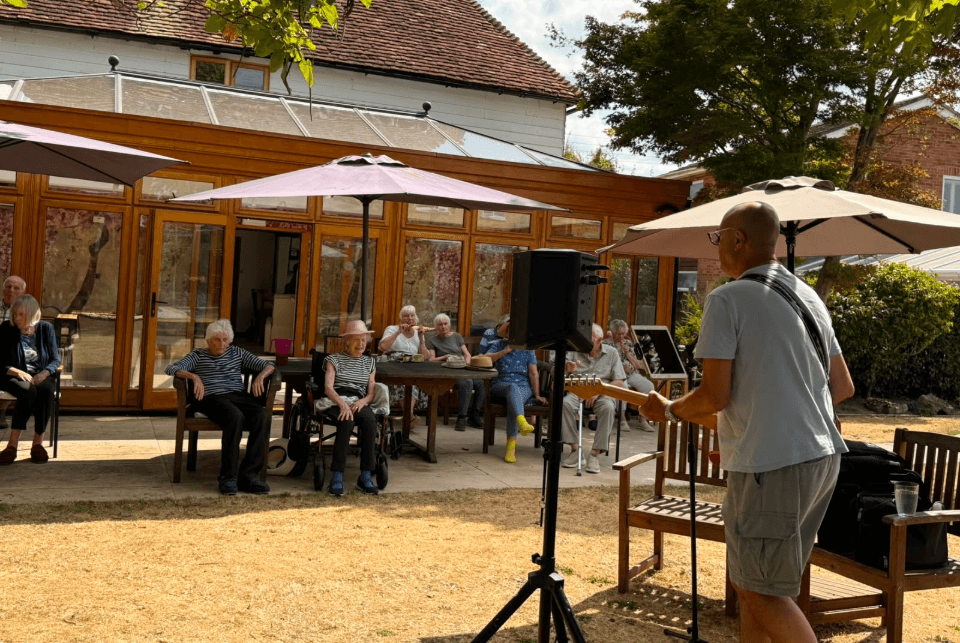
There isn't really a typical day at Farmhouse, and that's deliberate. We don't run residents through a fixed timetable, because dementia care built around a schedule tends to serve the schedule more than the person. What follows is more of a rhythm than a routine, the shape a day tends to take, even though the details are different for everyone living here.
Mornings move at different speeds
Some residents are up early, keen to get going. Others take their time, and there's no reason to rush them. Breakfast is available across a window rather than a single sitting, because being made to eat at a set time when you're not ready is exactly the kind of small indignity we try to design out of daily life.
For residents who enjoy it, mornings often include time in the garden, weather allowing, or a quieter moment with a cup of tea and the newspaper. Personal care happens at the pace that suits the individual, not a shift changeover.
The middle of the day is where the garden earns its reputation
Farmhouse's garden surprises most visitors with how big it is, and it gets used, not just admired from a window. Depending on the day and who fancies it, that might mean a walk, sitting outside in the sun, or simply having lunch with the doors open. Our minibus also goes out for local outings when residents want a change of scene beyond the grounds.
Lunch, like breakfast, isn't a single rigid sitting. Some residents prefer to eat somewhere quiet. Others enjoy the company of the dining room. Both are treated as equally valid ways to spend that time.
Afternoons bend around what each person actually enjoys
This is where person-centred care shows itself most clearly. One resident might spend the afternoon with music on, another with a jigsaw, another simply resting. Staff who know residents well tend to notice what someone needs on a given day, sometimes before the person says anything themselves.
The Hale Place team describe it like this:
"You learn quickly that a good afternoon looks completely different from one resident to the next. Our job isn't to fill the time for people. It's to notice what actually lifts someone's mood, and make room for it."
Evenings are kept calm, deliberately
Many people living with dementia find the late afternoon and early evening harder, sometimes known as sundowning, when confusion or anxiety can increase as daylight fades. We keep evenings low-key and predictable where we can: familiar surroundings, softer lighting, less noise and fewer changes of face. Dinner, like the other meals, happens at a pace that suits the person rather than the clock.
Family visits are part of the day, not an interruption to it
Visitors aren't confined to a set visiting hour, and there's no need to call ahead to check whether it's a "good time." Family members turn up across the day, some for a quick cup of tea, others to join a mealtime or sit in the garden for an afternoon. Residents who have regular visitors often have better days around those visits, not just during them, and we'd rather build the day around that than around a rota that suits us more than families.
The team behind the day
A day like this doesn't happen by accident. Care staff are the constant presence, the people who know whether someone prefers their tea strong or weak and notice when something's off before it becomes a problem. The kitchen team works around genuine preferences rather than a fixed menu handed down from a head office. And whoever's on shift, from the registered manager to the newest member of the team, should be able to speak to a family honestly about how someone's day has actually gone, not just recite that "everything's fine."
That continuity matters more in dementia care than almost anywhere else, because so much of what makes a day work well depends on being known, not just supervised.
What stays constant, even when the day doesn't
A few things don't change, whatever shape a particular day takes. Any member of staff should be able to tell a family honestly how someone's day has gone. Residents can choose to be outside, in company, or alone, without having to ask permission for something that should just be theirs to decide. And nobody's day is built around what's easiest to manage, even on a busy shift.
Seeing it for yourself
Reading about a day at Farmhouse only tells you so much. If you'd like to visit and see what an actual day looks like, get in touch and we'll show you round properly, not just the highlights reel. You can also read more about how Farmhouse came to work this way on our about us page.

Hale Place Care Solutions
79 Old Road, East Peckham
Tonbridge
Kent
TN12 5EN