



News & Articles
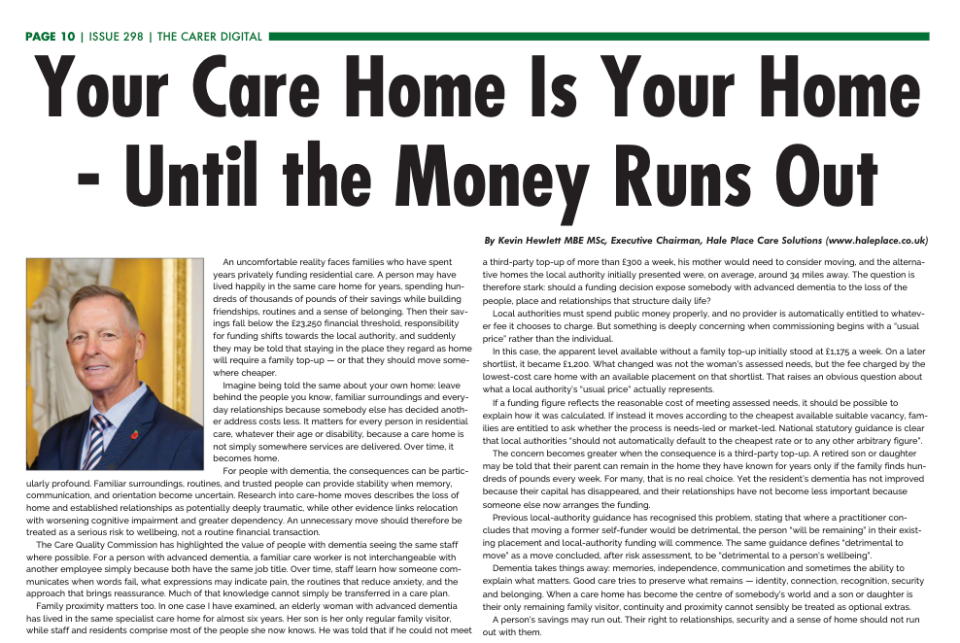
Featured in The Carer: Your Care Home is Your Home

Your Care Home Is Your Home
This month I wrote a feature for The Carer, on a subject that matters deeply to me: what happens to someone with dementia when their savings run out and the funding for their care home changes hands.
It's not really a story about money. It's a story about home.
A home, not a placement
Someone can live happily in the same care home for years. They build friendships. They learn the routines. They come to know the staff, and the staff come to know them, sometimes in ways that can't be written down in a care plan. Over time, that place stops being "a service" and simply becomes home.
Then, if their savings fall below the £23,250 threshold, responsibility for funding shifts to the local authority. And sometimes, that's when families are told the person may need to move somewhere cheaper, or that they'll need to find hundreds of pounds a week themselves to help them stay.
I try to put it simply in my piece: imagine being told the same thing about your own home. Leave behind the people you know and the everyday relationships you rely on, because somebody else decided another address would cost less.
Why this matters more for people with dementia
For someone with dementia, familiar surroundings and trusted, familiar faces can provide real stability, especially as memory and communication become harder. Research into care home moves describes the loss of home and established relationships as potentially deeply distressing, and links relocation with a decline in wellbeing. An unnecessary move isn't a routine administrative step. It's a genuine risk to someone's wellbeing.
The Care Quality Commission has recognised this too, highlighting how much value there is in people with dementia being able to stay with the same, familiar staff wherever possible.
A case that shows what's at stake
In my feature, I describe one case I've examined closely: a woman with advanced dementia who has lived in the same specialist care home for almost six years. Her son, her only regular visitor, was told his mother might need to move unless the family could cover a top-up of more than £300 a week. The alternative homes the local authority first suggested were, on average, around 34 miles away.
The figure available without a top-up had also shifted over time, not because the woman's needs had changed, but because it was pegged to the cheapest available bed on the list at any given moment.
I raise a straightforward but important question: when a funding figure is set, families deserve to understand how it was worked out, and whether it reflects what someone actually needs, or simply the lowest price on offer that week. National guidance is clear that local authorities shouldn't default to the cheapest rate as a matter of course.
What I believe
Dementia already takes things away: memories, independence, sometimes the words to explain what matters most. Good care is about holding on to what's left: identity, connection, familiarity and a sense of belonging.
When a care home has become the centre of someone's world, and family visits are already few and precious, I don't think continuity and closeness should be treated as optional extras. A person's savings can run out. I don't believe their right to a stable home, and the relationships within it, should run out with them.
You can read my full feature in The Carer here: https://issuu.com/thecarer/docs/the_carer_digital_-_issue_298

Hale Place Care Solutions
79 Old Road, East Peckham
Tonbridge
Kent
TN12 5EN